
Cleaning Schedule Printable
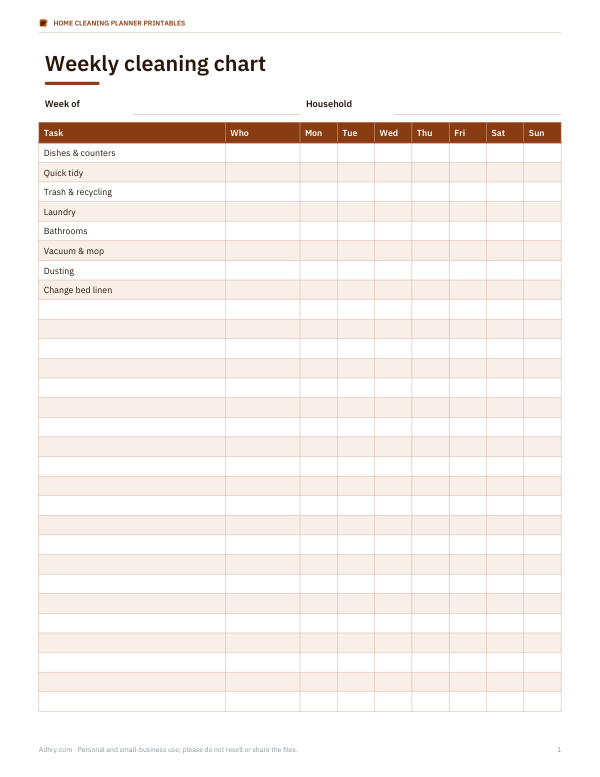
Build a cleaning schedule that fits your home in a few clicks. Choose the rooms you have, tick the tasks you want to track, set how often each happens and who does it, then print a clean one-page chart with tick boxes for every day of the week.
- Free to use
- No sign-up
- Runs in your browser
Make your cleaning schedule
Home Cleaning Planner Printables
A full-year cleaning planner: weekly charts, monthly and seasonal checklists, a deep-clean list and a chore rotation workbook.
- Weekly, monthly & seasonal printables (PDF, DOCX)
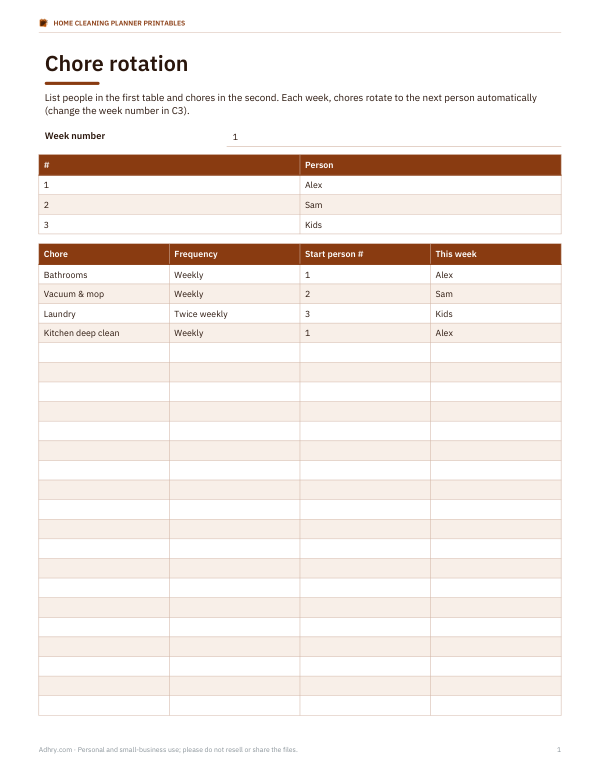
- Chore rotation workbook (XLSX)
Formats: PDF, DOCX, XLSX. Instant download after payment (link valid 72 hours, up to 5 downloads). AI-assisted: the templates were drafted with AI help and reviewed and laid out before publishing.
$4.00 USD, one-time
- Instant download
- 7-day refund
- Secure checkout by Stripe
7-day money-back guarantee. Full refund within 7 days of purchase, even after you download.
Full refund within 7 days — see the refund policy and license.
Free printables
Single sheets you can print right now, no sign-up. The full pack adds every sheet in one download plus the editable files.
How to use the schedule maker
- Tick the rooms you have. Each room opens a list of common tasks with a suggested frequency.
- Untick tasks you do not need, rename any task, and change how often it happens.
- Type the names of everyone who helps. Tasks without a name are shared out in turn automatically; type a name in the “Who” box to assign a task yourself.
- Choose a weekly grid with tick boxes, or a list grouped by frequency.
- Print it, or save it as a PDF from the print dialog, and put it somewhere everyone sees — the fridge, a cupboard door or the laundry room.
The weekly grid places daily tasks on every day, twice-weekly tasks on the second and fifth days, and weekly tasks on the sixth day of the week, which is usually a weekend day. Monthly and seasonal jobs appear in a separate table with a “done on” column, so they are not forgotten in a busy week.
Why a written schedule works
Most homes do not get messy because nobody cleans; they get messy because everyone cleans different things at different times and the same jobs keep being skipped. A written schedule turns vague intentions into small, specific tasks with a day and a person attached. It also makes the invisible work visible: when everyone can see that cleaning the bathroom is a weekly job with a name next to it, it is much easier to share fairly and much harder to leave to one person.
How often should you clean each room?
These frequencies are common starting points for a typical household. Adjust for the number of people, pets, allergies and how much time you spend at home.
| Frequency | Typical tasks |
|---|---|
| Daily | Dishes, kitchen counters and stove, quick tidy of living areas, wiping the bathroom sink, making beds |
| Twice a week | Trash and recycling, laundry loads, sweeping entry areas |
| Weekly | Toilets, showers and tubs, vacuuming and mopping floors, dusting, changing bed linen, washing towels |
| Monthly | Microwave and fridge clean-out, baseboards, windows, sofa cushions, cabinet fronts |
| Quarterly | Rotate mattresses, clean light fixtures, wash pillows, check smoke-alarm batteries |
| Twice a year | Gutters, deep-clean carpets, oven clean, wash curtains, declutter wardrobes |
Sharing chores fairly
- Rotate unpopular jobs weekly rather than assigning them permanently.
- Match tasks to ability: young children can make beds, sort laundry and dust low surfaces; teenagers can vacuum, clean bathrooms and cook simple meals.
- Count time, not tasks — one bathroom clean may equal three quick jobs.
- Agree on what “done” means for each task, especially for children, and keep the standard realistic.
- Review the chart after a month and change what is not working instead of abandoning it.
Worked example
A household of two adults and two children selects the kitchen, bathroom, bedrooms and living room, and enters “Alex, Sam, Kids”. The maker shares 21 tasks among them: daily dishes and counters go to Alex, the next task to Sam, the next to the kids, and so on. The printed grid shows the daily jobs with seven tick boxes each, weekly jobs such as vacuuming with a box on Saturday, and a small table of monthly jobs such as cleaning the fridge. Changing the “Who” box on the bathroom task to “Alex and Sam, alternate weeks” makes the arrangement explicit.
Adapting the schedule for pets, allergies and busy weeks
Homes with pets usually need floors vacuumed two or three times a week rather than weekly, and pet bedding washed weekly. For allergy sufferers, weekly washing of bedding in hot water and vacuuming with a sealed HEPA vacuum are commonly recommended, along with damp dusting rather than dry dusting. During busy periods — exams, a new baby, a house move — cut the chart back to the essentials: dishes, trash, laundry, bathroom sink and a ten-minute evening tidy. You can bring the rest back once things settle, and a slimmer chart that gets done is better than a full one that is ignored.
Making it stick
Schedules fail when they are too ambitious. Start with fewer tasks than you think you need, then add more once the routine holds for a few weeks. Pair tasks with existing habits — wipe the bathroom sink after brushing teeth, run the dishwasher after dinner, take the trash out on the way to the car on collection day. Set a short timer: fifteen to twenty minutes a day covers most daily and twice-weekly tasks in a small home. And print a fresh copy each week so ticking the boxes stays satisfying.
Cleaning supplies to keep ready
A schedule only works if the tools are where the job is. Keeping a small caddy in each bathroom and under the kitchen sink saves trips and excuses. A basic kit covers most tasks on the chart: an all-purpose cleaner, a bathroom cleaner or mild abrasive, dish soap, glass cleaner, microfibre cloths, a scrub brush, a toilet brush, a vacuum with attachments and a mop. Never mix bleach with ammonia or acidic cleaners, because the combination releases toxic gases, and store all cleaning products out of children's reach.
Frequently asked questions
Can I edit the tasks?
Yes. Rename any task, change its frequency, untick it or assign it to someone before printing.
How are tasks assigned if I leave “Who” empty?
They are shared out in turn among the names you entered, in the order they appear.
Can I save my schedule?
Print it or save it as a PDF, or download the CSV and open it in a spreadsheet. The page does not store your choices.
What paper size does it print on?
Whatever your printer uses — the chart scales to Letter or A4. Choose landscape for a wider grid.
How long should daily cleaning take?
For most small homes, 15–30 minutes a day keeps daily and twice-weekly tasks under control.
How often should sheets be changed?
Weekly is a common guideline for most adults; more often during illness, hot weather or for people with allergies.
What if we miss a day?
Skip it rather than doubling up the next day. Daily tasks catch up quickly, and the weekly grid shows what is still outstanding.